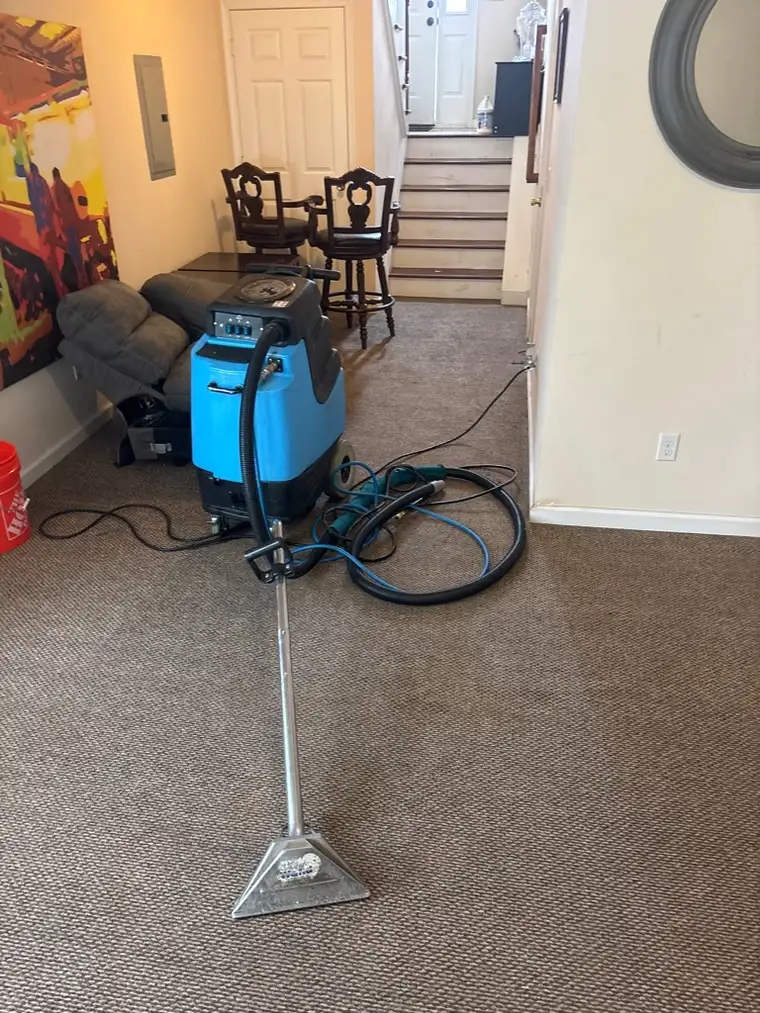
What do you need to move before the cleaner arrives?
Pick up the small items. We move the furniture.
That is most of it. Four other things cause nearly every avoidable problem on a visit.
What to clear, room by room
Off the floor entirely. Toys, shoes, laundry baskets, magazines, pet toys, dog bowls, litter trays, waste baskets, floor cushions, plant pots, chargers and cables. Anything a technician would have to pick up and move before the machine can pass. Across a whole house, that is where the time goes.
Off low surfaces. Anything breakable sitting on a coffee table, a low shelf or a windowsill at knee height. Hoses are dragged across the floor and can catch anything within reach.
Out of the way. Cables running across the floor. If a lamp or a router has to stay plugged in, say so and we will work around it.
Emptied, if the furniture is coming out. If a dresser or a bookcase needs to move, it moves far more safely empty. Anything holding electronics or glass, such as a TV unit or a display cabinet, is best cleared regardless.
What we move ourselves
Sofas, chairs, coffee tables, dining chairs, side tables, ottomans, anything two people can safely lift. We move it, clean underneath, and put it back with protective tabs under the feet so nothing marks the damp pile.
We generally do not move beds, large dressers, wardrobes, pianos, aquariums, or anything with a full water tank or a screen bolted to it. If a bed needs to move, tell us before the visit rather than on the day, because it changes how long the room takes.
If you prefer that we clean around certain pieces, tell us at the start of the visit.
The four things that cause almost every problem
1. The pet was not mentioned. Knowing changes the plan: the pre-treatment, the order of rooms, and where we look for contamination that is not visible. It also means the dog is not introduced to a running machine without warning.
2. The deadline was not mentioned. A room that has to be dry before tenants arrive at four decides whether we bring air movers. At booking that is routine. At 2pm it is a problem.
3. The building rules were not mentioned. A walk-up with no elevator, permitted working hours, a reserved service elevator, a certificate of insurance, no parking. Each of these is routine when known in advance and disruptive when discovered at the door. This matters most in Hoboken, Jersey City, Fort Lee and the newer Hackensack towers.
4. The worst stain was not pointed out. A stain that needs a specific pre-treatment has to be seen before the work starts. Showing us the worst area is the single most useful thing you can do.
Parking and the route in
Equipment is carried in from the street, and the length of hose and the number of trips depend on where we can park. If you have a driveway, leaving space helps. If your building has a loading area or a service entrance, telling us saves about ten minutes. Parking in Hoboken and downtown Jersey City is limited, and we plan for that, but knowing in advance lets us time the appointment properly.
Inside, a clear path from the door to the room being cleaned is enough. It does not need to be tidy, just passable.
What you do not need to do
Do not clean the carpet first. It makes no difference to the result, because a full vacuum is the first stage of the job.
Do not empty an entire room. It is unnecessary in almost every case.
You do not have to be home. Many jobs are done with a key, a code or a building concierge. Arrange access and tell us in advance which areas need attention.
Do not tidy the house first. We come to clean the floor in the condition it is in.
Afterwards
Stay off the cleaned rooms for the time we give you, and keep shoes off them for longer. Furniture goes back last, because foot marks and stain transfer into damp pile look permanent and are avoidable.
If you can, put a fan on and point it sideways across the floor rather than down at it. It is the cheapest way to halve a drying time.
If something looks wrong the next day, a mark that has surfaced or a smell that has returned, call us. Wicking is normal, and it is far easier to correct in the first week than in the second month.