A sump pump failing during a heavy storm does not give much warning. One minute the basement floor is dry, and twenty minutes later water is spreading under the carpet pad faster than most people expect. The first hour after a failure matters more than any step that follows, and getting the order right is what separates a carpet that dries out fine from one that has to be pulled up and replaced.
Power off before anyone steps in
Standing water in a finished basement is close to outlets, power strips and anything plugged in near floor level. Before stepping into water that is more than an inch or two deep, shut off power to the basement at the panel rather than relying on a single outlet switch. If the panel itself sits in or near the wet area, do not touch it. Call an electrician before entering the space at all. A pump that failed from a power outage is a different problem than one that failed with power still running to the house, and that distinction matters for what gets checked next.
Find where the water is coming from
Not every sump pump failure is the same failure. A pump can stop running entirely because the float switch is stuck or the motor burned out. A pump can keep running but still lose the fight if the volume of incoming water outweighs what it can discharge per minute. A check valve on the discharge line can fail and let water that already left the pit flow right back down into it, which looks like the pump is barely working even when it is not the real problem. Checking the pit, the float, and the discharge line tells you which of these happened and whether the same failure is likely to repeat before the basement is dry.
Lift what can still be lifted
Cardboard boxes, particleboard furniture legs and anything stored flat on the carpet pull water upward almost immediately, the same way a paper towel pulls water up from a wet counter. Moving boxes, rugs, electronics, cords and furniture with wood or composite legs onto blocks or a dry area of the floor in the first few minutes keeps that wicking from spreading further than it already has. Furniture with metal or plastic legs can usually stay in place a little longer without the same urgency.
Why the furnace fan should stay off
If the basement has forced air ductwork or a return vent near the flooded area, leave the furnace fan off rather than running it to circulate air. A fan pulling air across standing or recently flooded carpet pushes moisture and whatever odor has started into the ductwork, and from there into upper floors of the house. It also adds risk if any electrical component near the furnace has gotten wet. Air movers brought in during a proper drying setup do the job of moving air without pulling it through the home's duct system.
Photograph before anything gets moved or dried
Before lifting carpet corners, blotting water, or shifting furniture further than the minimum needed, take wide photos of each affected room, the water line on the walls if there is one, and the sump pit or discharge line itself. Photos taken before anything is touched are more useful later than photos taken after the room has already been partly rearranged. This step takes two minutes and costs nothing, and it is the kind of thing that is impossible to go back and redo once the water is gone and the furniture is back in place.
What an extraction visit does first
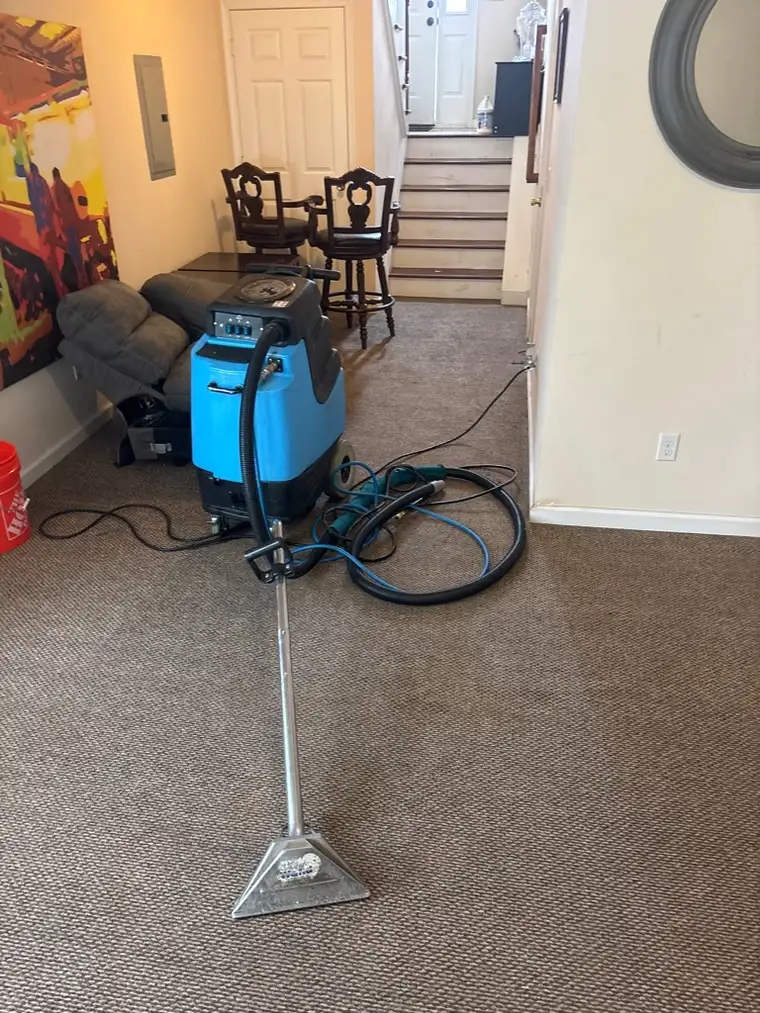
When a technician arrives, the first step is not pulling out a wet vac. It starts with a moisture reading across the carpet, the pad underneath, and the subfloor itself, since those three layers rarely hold the same amount of water. That reading, combined with how long the water has likely been sitting, sets the plan for the rest of the visit. Standing water comes out first with extraction equipment built for volume rather than a shop vacuum, and air movers and a dehumidifier go in once the bulk of the water is gone, not before.
Why the pad decides if the carpet is saved
Carpet fiber itself holds up to water reasonably well once it is extracted, dried and cleaned. The pad underneath is a different material entirely. It behaves like a sponge, and once it has absorbed water for several hours, it rarely dries back to where it was before, especially if the water sitting in it was not clean to start with. A pad that stays saturated under carpet that looks dry on top is what leads to odor and soft spots weeks later. Our article on whether wet carpet can be saved after a leak goes into how that decision gets made room by room.
| What you see | What it usually means |
|---|---|
| Carpet feels damp but the pad underneath feels dry when pressed | Water has not fully worked through yet, and fast extraction has a good chance of saving both layers |
| Pad feels squishy or cold under the carpet across a wide area | Water has been sitting long enough to soak the pad fully, which often means pad replacement |
| A musty smell starts within a day or two | Moisture has been trapped against the pad or subfloor long enough to begin supporting odor |
| Water came from the pit itself rather than a pipe or appliance | Groundwater intrusion often carries more sediment than a clean water leak and changes how the area is treated |
When to call us
We handle sump pump failures and basement flooding in Hoboken, Secaucus, Sayreville and Perth Amboy, along with the rest of Hudson and Middlesex counties, including homes where the basement is fully finished and carpeted.
If a sump pump failure has already soaked the basement carpet, describe how long the water sat and roughly how deep it got, and we will walk through what an extraction visit involves and send a written estimate before anything is scheduled. Our piece on the first 24 hours after a leak and the one on what homeowners insurance in NJ typically covers are both worth reading while you wait.