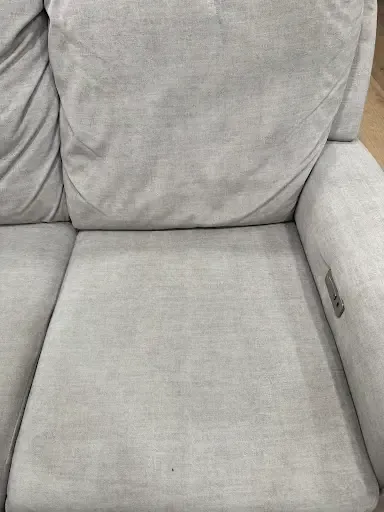
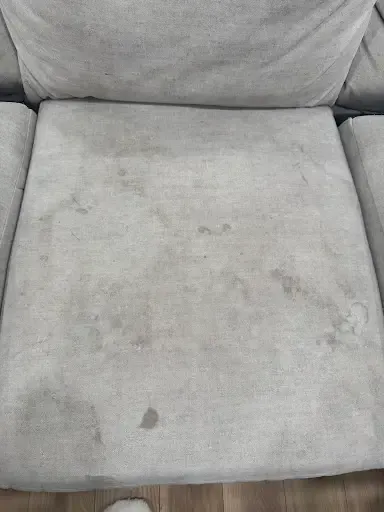
Two photographs of the same seat. The first shows the sofa as we found it. The second shows the same cushion after a low moisture clean.
The condition on arrival
The seat read grey and uneven. Darker marks ran through the middle of the cushion, one spot near the front edge had a harder outline than the rest, and a curved mark sat toward the arm. Around all of it the fabric had gone flat and dull. The panel was soiled across its whole surface, with a few areas worse than the rest.
The cause of the marks is not recorded for this job. What decides the work is whether a mark sits in the fabric or the fabric itself has changed.
Soil and body oil sit in the fabric and can be released and drawn back out. Sun fade, bleach contact and dye loss are changes in the fabric itself, and nothing applied on top puts color back. Soft edges and a wider dullness usually indicate soil. A hard outline with clean fabric against it usually indicates dye loss. On this seat the marks came out.
Why is the fabric tested before any moisture?
A test patch is the first step on every fabric piece we clean. Before the cushion gets wet, we test a hidden part of the same fabric: under the skirt, on a back panel, or on the underside of the seat. Some fabrics release dye. Some mark from plain water.
Finding that on a back panel costs nothing. Finding it in the middle of the seat cannot be undone. When a fabric fails the test we say so and stop.
What we did
- Tested a hidden panel of the same fabric first.
- Vacuumed the seat, the crevices and the deck under the cushion.
- Pre-treated the duller areas before any extraction.
- Cleaned the face fabric by low moisture extraction, with the solution drawn straight back out so the foam underneath never soaked.
- Worked out to the seams, so the cleaned area has no visible border.
- Left the sofa to dry with air moving through the room.
Low moisture is the method for upholstery because a sofa is several materials stacked together: the face fabric, the foam core, the deck under the cushions and the frame. Foam holds water for days, and the middle of a cushion cannot be aired out. The solution goes in at a fraction of what a carpet takes and comes back out through the same head.
Why did the whole cushion change color?
Most customers book because of the spots. The second photograph usually shows them the rest. The seat reads as one even color again and the weave is legible, because the film across the top is no longer scattering the light.
That film builds up slowly and evenly, so there is never a day when the sofa looks worse than the day before. A pair of photographs is often the first time an owner sees how far it had gone. It is also why a cleaned sofa can leave the carpet under it looking tired, and why we often suggest cleaning both in one visit.
What you should know
- A fabric sofa usually dries in 4 to 8 hours, and it can take longer in cold or humid weather. The fabric, the room and the weather move the figure within that range.
- A photograph tells us more than a description. Send a picture of the worst area before you book and we will tell you what we think it is.
- Some marks stay. When we believe something is dye loss or damage rather than soil, you hear it at the estimate and not after the invoice.
- You receive a written estimate before any work begins. All services are performed at your home or business, and appointments are available 24 hours a day.
- The products are non-toxic and biodegradable. No one has to leave the room while we work, and no ventilation is required afterwards.
When to call us
Call when the seats have gone a shade darker than the arms, or when a sofa looks tired in a way vacuuming does not fix. What we clean and what we will not attempt is set out on Sofa and upholstery cleaning. We work across eight counties in North Jersey and Central Jersey, including Essex County and Union County. More completed work is on Before and after, and common questions are answered on Frequently asked questions.